Wednesday, September 30, 2009

Lepidolite Crystal Stone

Discovered in the eighteenth century, it is not a typical gemstone, but a very beautiful purplish type of mica that contains a substantial portion of lithium and is the Earth’s most common lithium-bearing mineral. Lepidolite is from the Greek ‘lepidos’, meaning ‘scale’, and ‘lithos’, meaning ‘stone’. Lepidolite was uncommon mica but in recent years Brazilian finds have made it much more available on the mineral market. Lepidolite, like other micas, has a layered structure of lithium aluminum silicate sheets weakly bonded together by layers of potassium ions. These potassium ion layers produce the perfect cleavage.

The typical violet to pink color of Lepidolite is characteristic and is the only field test available to identify Lepidolite from other micas. Pink muscovite or very pale Lepidolite may confuse identification. Since Lepidolite colors can be confusing, a melting and flame test is desirable if there is any reason - such as the presence of colored tourmalines or of other lithium minerals for suspecting mica to be Lepidolite, rather than the commoner muscovite. The fluorescence and flame tests will also distinguish some of the more intensely colored chromium chiorites, dumortierite, and similar hydrous silicates.

Lepidolite crystals accompany other lithium bearing minerals such as tourmaline, amblygonite and spodumene. Lepidolite crystals can add character and value of these specimens. Crystals can be tabular or prismatic crystals with a prominent pinacoid termination. Lepidolite's four prism faces and two pinacoid faces form pseudo-hexagonal crystal "books". Well developed crystals with a Sharp hexagonal outline are rare. The sides of the crystal often tend to taper. Sometimes borders ordinary muscovite mica, but the cleavage flakes are not quite continuous. Commonly occurs in medium to fine-grained aggregates; One- to two-inch crystals, tapering down to a slender point and more prismatic than tabular, occur at some localities.

Traditional properties of Lepidolite include protection from outside influences, relieve everyday stress, and promote restful sleep when placed near your pillow, attracts good luck and drives away negativity.


Lepidolite provided by Panther Creek Minerals, San Antonio, Texas.
Researched from various websites, mineral-rock-gem and crystal books.

Monday, September 28, 2009

Wire Wrapped Ex-Large Pendants

I got the challenge from Panther Creek Minerals to wire wrap several very large agate slices. It was a little challenging, because I hadn’t ever taken on such large pendant sizes to wire wrap; but I did succeed and these are the results. Each Brazilian ex-large agate slice pendant has been carefully handcrafted with either non-tarnish artistic silver or bronze wire.


Agates: Balancing physical, emotional, intellectual and spiritual energies; perceptiveness, strength, inspiration, awakening talents.

Sunday, September 27, 2009

Leftover Turquoise Pieces

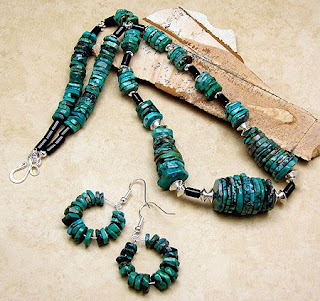
Every wonder what happens to the leftover Turquoise pieces; left on the floors and scattered around many mining and cutting lapidary company….maybe the answer is in this strand of Turquoise disks. A mix and maze of different Turquoise pieces ranging in color from blue to green and beautifully matrixes in brown, black, rust, cream, yellow, and even green and blue. The disks are cut in a rough hex, stabilized and graduated to form stunning bead structures.

This design takes that stunning mixture and highlights it with Onyx, sterling silver spacers and toggle; mounds of Turquoise in dangle hoops can be worn with the necklace or accented with other pieces.

Uniquely handcrafted custom natural stone jewelry, browse and purchase from our website.

Saturday, September 26, 2009

Mystery Gem or Mis-Mash

I found this to be an interesting tidbit from the Color Stone Newsletter’s ‘mystery gem game’; is it a mis-mash or astronomy phenomenon? To find out more, read on……

Suddenly gems with multiple personalities are becoming all the rage and gemologists are as baffled by their identities as psychologists might be by patients with multiple personalities. This gem displays evidence of at least eight distinct mineral strains in its complex makeup. What is this gem’s marketing name, and why are we featuring it? Here’s a clue: study the picture of the gem and determine what sky-watcher’s phenomenon it reminds you of.

If you’re familiar with astronomy, you’ll notice a more than subjective resemblance between the black body color and orb-covered patterned surface of this gem and what are known as spiral nebulae. Hence the stone was named "nebula stone" by its discoverers
Karen and Ron Nurnberg, who lucked upon it during a camping trip in southern Mexico in 1994. To this day, theirs is the only known deposit of this ornamental rock. So don’t ask them for directions to the mining site. We had to beg for the vague locality information contained here. Of course, you’re wondering about the stone’s gemological identity. Well, so are the mineralogists who have studied the stone and found traces of quartz, four feldspars (riebeckite, arfedsonite, anorthoclase and aegirine), acmite, calcite and zircon. No wonder an undecided classification debate is on for this gem. Is it, like unakite, a partial feldspar that acts as a kind of foster father for this material? We thought so, and decided to use it as a poster child for the very strange alkali branch of the feldspar family—a huge, sprawling gem group.

Reprinted from Colored Stones Newsletter

Friday, September 25, 2009

Wild Horse Crystals & Turquoise Mixed Design

Another new design for our fall collection! This one is a beauty in Wild Horse Magnesite disks, accented by hex light Topaz crystals and gold-tone spacers and hanging from the center is a brown matrix Turquoise cross, handcrafted bail in non-tarnish brass wire. Wear it long or short with the extender and matching dangle earrings.


Turquoise: Spiritual attunement, cleansing, healing, protection, valor, soothing, peace of mind, guidance through the unknown, romantic spontaneity.

Magnesite: Promotes original and dynamic ideas. Instills peace, good for meditation, eliminate self-deceit and stimulate passion.

Custom handcrafted natural gemstone designs, visit and shop our website!

Wednesday, September 23, 2009

Ammonites of Madagascar


Ammonites are an extinct group of marine animals belonging to the cephalopod subclass Ammonoidea and are excellent index fossils. They are utilized by geologists and paleontologists to link the rock layer in which they are found to specific geological time periods. The closest living relative of the ammonite, is not the modern Nautilus, which they somewhat outwardly resemble, but rather the octopus, squid and cuttlefish. Their fossil shells usually take the form of planispirals, although there were some helically-spiraled and non-spiraled forms (known as "heteromorphs"). They ranged from the lower Jurassic (200Ma) to the Upper Cretaceous (65.5Ma).


Ammonites provided by Panther Creek Minerals, San Antonio, Texas.


Custom handcrafted jewelry designs, visit our website.

Monday, September 21, 2009

Bead Shopping Hints – Part II

As a follow-up, here are some helpful hints and guides to bead shopping at all the shows!! Good luck and enjoy!

1) So when will bead shows be in your area? Check the sites of your favorite venders they often list what shows they attend through-out the year.

2) Set a budget as to what you will spend; this may be determined by stock you are out of and some left over for purchases of specialty items.

3) Bring a couple of checks, plenty of cash and your credit cards just in case you run into someone who doesn’t take one or the other.

4) Be sure to bring a copy of your Tax ID certificate and business cards. Some shows are known as wholesale only and will require these items for entrance. If it is a public show, don’t be afraid to ask the vendors for a wholesale discount and provide both these items to them to get a discount.

5) Make a list of items you are out of; these will be the first things to look for at the show. If I know that I’ll be buying from previous vendors, I’ll group those items together on the list for ease.

6) I also make a list of items I am looking for and want; it could be stones or pendants I’ve seen online or a combination of colors in another design. This helps to keep the ‘impulse’ buying down by knowing what you are looking for and can afford.

7) Wear comfortable shoes and bring a bag to load all your goodies into.

8) Include in your shopping bag several sizes of zip lock bags; as you find things that go together, put them in the little baggies, this makes it easy to determine why you purchased these little gems when you get home.

9) Paper and pen; I bring paper and pen to mark bead names if they are not already marked. This makes identifying much easier than guessing or having to go through the process to indentify each unknown stone or pendant.

10) Bring baby wipes for easy cleanup; looking through tons of strands of beads and boxes of findings can get a little messy and dusty.

11) Take brakes and rest, get something to eat, drink and take time to review your shopping list and bag; typically it takes an entire day to attend a bead show.

12) Last but not least; this takes willpower but walk the entire show first to see what is available, check out pricing and watch what others are buying. Many vendors have the same products and offer different discounts; look for the best quality and prices available. Make note as to vendors you want to return to for purchases of those goodies after you have finished walking the whole show.

13) Above all --- be a smart shopper and have fun!

Wednesday, September 30, 2009

Lepidolite Crystal Stone

Discovered in the eighteenth century, it is not a typical gemstone, but a very beautiful purplish type of mica that contains a substantial portion of lithium and is the Earth’s most common lithium-bearing mineral. Lepidolite is from the Greek ‘lepidos’, meaning ‘scale’, and ‘lithos’, meaning ‘stone’. Lepidolite was uncommon mica but in recent years Brazilian finds have made it much more available on the mineral market. Lepidolite, like other micas, has a layered structure of lithium aluminum silicate sheets weakly bonded together by layers of potassium ions. These potassium ion layers produce the perfect cleavage.

The typical violet to pink color of Lepidolite is characteristic and is the only field test available to identify Lepidolite from other micas. Pink muscovite or very pale Lepidolite may confuse identification. Since Lepidolite colors can be confusing, a melting and flame test is desirable if there is any reason - such as the presence of colored tourmalines or of other lithium minerals for suspecting mica to be Lepidolite, rather than the commoner muscovite. The fluorescence and flame tests will also distinguish some of the more intensely colored chromium chiorites, dumortierite, and similar hydrous silicates.

Lepidolite crystals accompany other lithium bearing minerals such as tourmaline, amblygonite and spodumene. Lepidolite crystals can add character and value of these specimens. Crystals can be tabular or prismatic crystals with a prominent pinacoid termination. Lepidolite's four prism faces and two pinacoid faces form pseudo-hexagonal crystal "books". Well developed crystals with a Sharp hexagonal outline are rare. The sides of the crystal often tend to taper. Sometimes borders ordinary muscovite mica, but the cleavage flakes are not quite continuous. Commonly occurs in medium to fine-grained aggregates; One- to two-inch crystals, tapering down to a slender point and more prismatic than tabular, occur at some localities.

Traditional properties of Lepidolite include protection from outside influences, relieve everyday stress, and promote restful sleep when placed near your pillow, attracts good luck and drives away negativity.


Lepidolite provided by Panther Creek Minerals, San Antonio, Texas.
Researched from various websites, mineral-rock-gem and crystal books.

Monday, September 28, 2009

Wire Wrapped Ex-Large Pendants

I got the challenge from Panther Creek Minerals to wire wrap several very large agate slices. It was a little challenging, because I hadn’t ever taken on such large pendant sizes to wire wrap; but I did succeed and these are the results. Each Brazilian ex-large agate slice pendant has been carefully handcrafted with either non-tarnish artistic silver or bronze wire.


Agates: Balancing physical, emotional, intellectual and spiritual energies; perceptiveness, strength, inspiration, awakening talents.

Sunday, September 27, 2009

Leftover Turquoise Pieces

Every wonder what happens to the leftover Turquoise pieces; left on the floors and scattered around many mining and cutting lapidary company….maybe the answer is in this strand of Turquoise disks. A mix and maze of different Turquoise pieces ranging in color from blue to green and beautifully matrixes in brown, black, rust, cream, yellow, and even green and blue. The disks are cut in a rough hex, stabilized and graduated to form stunning bead structures.

This design takes that stunning mixture and highlights it with Onyx, sterling silver spacers and toggle; mounds of Turquoise in dangle hoops can be worn with the necklace or accented with other pieces.

Uniquely handcrafted custom natural stone jewelry, browse and purchase from our website.

Saturday, September 26, 2009

Mystery Gem or Mis-Mash

I found this to be an interesting tidbit from the Color Stone Newsletter’s ‘mystery gem game’; is it a mis-mash or astronomy phenomenon? To find out more, read on……

Suddenly gems with multiple personalities are becoming all the rage and gemologists are as baffled by their identities as psychologists might be by patients with multiple personalities. This gem displays evidence of at least eight distinct mineral strains in its complex makeup. What is this gem’s marketing name, and why are we featuring it? Here’s a clue: study the picture of the gem and determine what sky-watcher’s phenomenon it reminds you of.

If you’re familiar with astronomy, you’ll notice a more than subjective resemblance between the black body color and orb-covered patterned surface of this gem and what are known as spiral nebulae. Hence the stone was named "nebula stone" by its discoverers
Karen and Ron Nurnberg, who lucked upon it during a camping trip in southern Mexico in 1994. To this day, theirs is the only known deposit of this ornamental rock. So don’t ask them for directions to the mining site. We had to beg for the vague locality information contained here. Of course, you’re wondering about the stone’s gemological identity. Well, so are the mineralogists who have studied the stone and found traces of quartz, four feldspars (riebeckite, arfedsonite, anorthoclase and aegirine), acmite, calcite and zircon. No wonder an undecided classification debate is on for this gem. Is it, like unakite, a partial feldspar that acts as a kind of foster father for this material? We thought so, and decided to use it as a poster child for the very strange alkali branch of the feldspar family—a huge, sprawling gem group.

Reprinted from Colored Stones Newsletter

Friday, September 25, 2009

Wild Horse Crystals & Turquoise Mixed Design

Another new design for our fall collection! This one is a beauty in Wild Horse Magnesite disks, accented by hex light Topaz crystals and gold-tone spacers and hanging from the center is a brown matrix Turquoise cross, handcrafted bail in non-tarnish brass wire. Wear it long or short with the extender and matching dangle earrings.


Turquoise: Spiritual attunement, cleansing, healing, protection, valor, soothing, peace of mind, guidance through the unknown, romantic spontaneity.

Magnesite: Promotes original and dynamic ideas. Instills peace, good for meditation, eliminate self-deceit and stimulate passion.

Custom handcrafted natural gemstone designs, visit and shop our website!

Wednesday, September 23, 2009

Ammonites of Madagascar


Ammonites are an extinct group of marine animals belonging to the cephalopod subclass Ammonoidea and are excellent index fossils. They are utilized by geologists and paleontologists to link the rock layer in which they are found to specific geological time periods. The closest living relative of the ammonite, is not the modern Nautilus, which they somewhat outwardly resemble, but rather the octopus, squid and cuttlefish. Their fossil shells usually take the form of planispirals, although there were some helically-spiraled and non-spiraled forms (known as "heteromorphs"). They ranged from the lower Jurassic (200Ma) to the Upper Cretaceous (65.5Ma).


Ammonites provided by Panther Creek Minerals, San Antonio, Texas.


Custom handcrafted jewelry designs, visit our website.

Monday, September 21, 2009

Bead Shopping Hints – Part II

As a follow-up, here are some helpful hints and guides to bead shopping at all the shows!! Good luck and enjoy!

1) So when will bead shows be in your area? Check the sites of your favorite venders they often list what shows they attend through-out the year.

2) Set a budget as to what you will spend; this may be determined by stock you are out of and some left over for purchases of specialty items.

3) Bring a couple of checks, plenty of cash and your credit cards just in case you run into someone who doesn’t take one or the other.

4) Be sure to bring a copy of your Tax ID certificate and business cards. Some shows are known as wholesale only and will require these items for entrance. If it is a public show, don’t be afraid to ask the vendors for a wholesale discount and provide both these items to them to get a discount.

5) Make a list of items you are out of; these will be the first things to look for at the show. If I know that I’ll be buying from previous vendors, I’ll group those items together on the list for ease.

6) I also make a list of items I am looking for and want; it could be stones or pendants I’ve seen online or a combination of colors in another design. This helps to keep the ‘impulse’ buying down by knowing what you are looking for and can afford.

7) Wear comfortable shoes and bring a bag to load all your goodies into.

8) Include in your shopping bag several sizes of zip lock bags; as you find things that go together, put them in the little baggies, this makes it easy to determine why you purchased these little gems when you get home.

9) Paper and pen; I bring paper and pen to mark bead names if they are not already marked. This makes identifying much easier than guessing or having to go through the process to indentify each unknown stone or pendant.

10) Bring baby wipes for easy cleanup; looking through tons of strands of beads and boxes of findings can get a little messy and dusty.

11) Take brakes and rest, get something to eat, drink and take time to review your shopping list and bag; typically it takes an entire day to attend a bead show.

12) Last but not least; this takes willpower but walk the entire show first to see what is available, check out pricing and watch what others are buying. Many vendors have the same products and offer different discounts; look for the best quality and prices available. Make note as to vendors you want to return to for purchases of those goodies after you have finished walking the whole show.

13) Above all --- be a smart shopper and have fun!