Thursday, August 5, 2010

Striking Mix of Bold Colors

Ok, I have to admit that this design in the bold colors of red, black, white and silver are extremely striking together. The design is new for me and I’ve taken a mix of different techniques to combine and put this piece together. And so far it’s begun to be a big hit and I’ve been asked to create more in different colors and styles!

The necklace focal center is designed to stay stationary on either a silk cord or a ribbon cord. I’ve used in this case a large chunk of coral (dyed) in a thick oval shape; then surrounded it in single coils. To accent the pendant, I’ve hand charmed 36 pieces different shapes of stones coral, freshwater cultured pearls, black agate, and Swarovski crystals; between I’ve added a couple of double spiral coils and then capped the entire piece into a stationary position with wired coils and swirls that becomes part of the design.

The whole piece is quite labor intensive taking quite a bit of time to design, mix/match colors and stones, then hand charm each one and either wire, bail or get creative with the pendant. The matching earrings are the same double coils and stones from the necklace – all wire is done in non-tarnish silver wire.


Keep watching as I’ll be doing many more of these inspirations from the many pendants, stones and metals that I have!

This design along with many other uniquely artisan crafted jewelry pieces are available at our online shop!


Agates: Balancing physical, emotional, intellectual and spiritual energies; perceptiveness, strength, inspiration, awakening talents.
Coral: Diplomacy, quieting emotions, visualization.
Pearl: Purity, faith, charity, innocence, integrity, focus, wisdom, spirituality, sincerity, fertility.

Wednesday, August 4, 2010

Trendy Southwestern Mix

Working with stones I sometimes get a desire to do multiple strand necklaces; not often, but there are times when the stones and design just come together. In this creation, I started with rare ivoryite stones from the Arizona mines; accented with silver spacers and did half the necklace in raw stabilized turquoise chips beautiful earthy tones and the base of the necklace are tiny marbled onyx tubes.


Ivoryite is a wonderful and versatile stone to work with; it is a very unique variety of extremely fine grained mineral called magnesite; it is a natural mineral and not man-made as most people think. Quarried by hand, this stone looks and feels like soft silky ivory; it can be worked with metal tools, but cuts effortlessly with diamond tools making it excellent material for inlay, cabochons and small carvings.

Find your wearable earth, custom design jewelry at our online shop!

Turquoise: Spiritual attunement, cleansing, healing, protection, valor, soothing, peace of mind, guidance through the unknown, romantic spontaneity.

Onyx: Self-control, decision making, intuition, recognition of personal strengths.

Monday, August 2, 2010

Haze of Purple Agate

Agates are an amazing natural stone; they come in an array of colors and the combinations incredible. This new design is in purple agates and crystals. The highly polished pendant is cut in a crescent moon shape with varying shades of light lilac and coppery veins.


The strands are of unusual heat treated faceted crystals that change color depending on the light; from deep purples to orchid and into light blue/purple shade; an incredible design with multiple dimensions; a few faceted round agates capped in sterling silver have been added for flavor and spice. The long dangle earrings include the same stones and crystals in the cluster style, that is hitting new designs everywhere.


Find your custom artisan crafted piece at our online shop!

Agates: Balancing physical, emotional, intellectual and spiritual energies; perceptiveness, strength, inspiration, awakening talents.

Sunday, August 1, 2010

Redesigns Gone Wired

These two designs were ok at first but never really showed off the beauty of the crystals and stones with a little spark. To do them both justice and add a little spark, I added silver wire to one and re-designed the other.


A simple and casual design with coral fossil, Swarovski crystals and blue denim lapis; which has been accented with non-tarnish silver wire.


This one needed more than just crystal, this design I re-worked and to enhance the pendant I accented with black non-tarnish wire and onyx tubes; clusters of crystals pink and copper with black Swarovski cosmo crystals really sets off the Japanese artistic jasper pendant.


These designs and other wired, chic jewelry are available online at our shop!

Sunday, July 25, 2010

Aventurine the Stone

Aventurine is the name given to a variety of quartz that has a spangled appearance due to sparkling internal reflections from uniformly oriented minute inclusions of other minerals. It is always massive; green aventurine is colored by green fuchsite mica; brown aventurine is colored by pyrite; and reddish-brown aventurine is due to hematite. Other inclusions can color the mineral orange, bluish-white, yellow, or bluish-green.

Aventurine feldspar or sunstone can be confused with orange and red aventurine quartzite, although the former is generally of a higher transparency. Aventurine is often banded and an overabundance of fuchsite may render it opaque, in which case it may be mistaken for malachite at first glance.

The name aventurine derives from the Italian "a ventura," meaning "by chance." This is an allusion to the chance discovery of aventurine glass or goldstone at some point in the 18th century. Although it was known first, goldstone is now a common imitation of aventurine and sunstone. Goldstone is distinguished visually from the latter two minerals by its coarse platelets of copper, dispersed within the glass in an unnaturally uniform manner. It is usually a golden brown, but may also be found in blue or green.

The majority of green and blue-green aventurine originates in India, particularly in the vicinity of Mysore and Madras, where it is employed by prolific artisans. Creamy white, gray and orange material is found in Chile, Spain and Russia.

Historically it is said that in ancient Greece aventurine was sewn into the clothes of men going to war to preserve their courage and optimism. It is said also enhance the sense of humor, cheerfulness, mental agility, peach, an open heart, motivation and promote leadership of those who wear it. It symbolizes tranquility and patience and gives the wearer inner equilibrium and stimulates dreaming.


This design is a hand-charmed cluster of aventurine surrounding a button fossil Ammonite.

Artisan crafted jewelry available on our
online shop!


*Research from various mineral/rock books & websites

Friday, July 23, 2010

Cluster of Crystals & Dichroic Glass


This is a different and new design in that it is a melt of different techniques. It starts with a focal pendant in dichroic glass from one of the premier glass artists in San Antonio; soft shades of lime green, gold, pink and cream set against a black background.


Surrounding the pendant are 36 individually hand-charmed pieces; in accents of faceted Swarovski crystals hot pink padparadscha and glass pearls in complimenting colors of cream, mauve, copper, tan, and metallic green crystals. Between are hand-swirls spirals in non-tarnish brass wire and non-tarnish brass spiral ends for accents. It is set stationary onto the silky 18” tan cord and has matching dangle cluster earrings.


Keep watching as we’ll be doing this design using many other pendants, cords and techniques!


Eclectic artisan crafted jewelry from fossils, glass, and stone incorporated with metals and wire techniques; visit our online Shop for available pieces to purchase!

Sunday, July 18, 2010

Spiny Oyster & Jewelry

Some of the most incredible Southwestern and Indian jewelry is made with Spiny Oyster beads. The colors of these beads vary from pink to purple and from light to deep orange. Spiny oyster beads come from the spiny oyster shell, or Spondylus, harvested from the Sea of Cortez, Baja California and Mexico. Different types of Spondylus may also be found in the warm waters off the coasts of Central and South America. Spondylus is Latin for “spines on its back,” which is appropriate for this beautify and difficult to harvest shell.

It was hard to find information about just the beads, but I did find out about the Spiny Oyster Shell from the Wikipedia. “Spondylus is a genus of bivalve mollusks, the only genus in the family Spondylidae. As well as being the systematic name, Spondylus is the most often used common name for these animals, though they are also known as thorny oysters or spiny oysters.

There are many species of Spondylus, and they vary considerably in appearance and range. They are grouped in the same super family as the scallops, but like the true oysters (family Ostreidae) they cement themselves to rocks, rather than attaching themselves by a byssus. Their key characteristic is that the two parts of their shells are hinged together with a ball and socket type of hinge, rather than a toothed hinge as is more common in other bivalves. Spondylus have multiple eyes around the edges of the shell, and they have a relatively well developed nervous system. Their nervous ganglia are concentrated in the visceral region, with recognizable optic lobes, connected to the eyes. Spondylus shells are much sought after by collectors, and there is a lively commercial market in them.

Archaeological evidence shows that people in Neolithic Europe were trading the shells of Spondylus gaederopus to make bangles and other ornaments as long as 5,000 years ago (Varna necropolis). The shells were harvested from the Aegean Sea but were transported far into the centre of the continent. In the LBK and Lengyel culture, Spondylus shells from the Aegean Sea were worked into bracelets and belt-buckles.

Spondylus princeps are also found off the coast of Ecuador, and have been important to Andean peoples since pre-Columbian times, serving as offerings to the Pachamama as well as some kind of currency. In fact much like in Europe the Spondylus shells also reached far and wide as pre-Hispanic Ecuadorian peoples traded them with peoples as far north as present-day Mexico and as far south as the central Andes. The Moche people of ancient Peru worshipped animals and the sea and often depicted Spondylus shells in their art.


Browse our online shop to purchase designs in spiny oyster!

*Parts have been reprinted from the Wikipedia.

Thursday, August 5, 2010

Striking Mix of Bold Colors

Ok, I have to admit that this design in the bold colors of red, black, white and silver are extremely striking together. The design is new for me and I’ve taken a mix of different techniques to combine and put this piece together. And so far it’s begun to be a big hit and I’ve been asked to create more in different colors and styles!

The necklace focal center is designed to stay stationary on either a silk cord or a ribbon cord. I’ve used in this case a large chunk of coral (dyed) in a thick oval shape; then surrounded it in single coils. To accent the pendant, I’ve hand charmed 36 pieces different shapes of stones coral, freshwater cultured pearls, black agate, and Swarovski crystals; between I’ve added a couple of double spiral coils and then capped the entire piece into a stationary position with wired coils and swirls that becomes part of the design.

The whole piece is quite labor intensive taking quite a bit of time to design, mix/match colors and stones, then hand charm each one and either wire, bail or get creative with the pendant. The matching earrings are the same double coils and stones from the necklace – all wire is done in non-tarnish silver wire.


Keep watching as I’ll be doing many more of these inspirations from the many pendants, stones and metals that I have!

This design along with many other uniquely artisan crafted jewelry pieces are available at our online shop!


Agates: Balancing physical, emotional, intellectual and spiritual energies; perceptiveness, strength, inspiration, awakening talents.
Coral: Diplomacy, quieting emotions, visualization.
Pearl: Purity, faith, charity, innocence, integrity, focus, wisdom, spirituality, sincerity, fertility.

Wednesday, August 4, 2010

Trendy Southwestern Mix

Working with stones I sometimes get a desire to do multiple strand necklaces; not often, but there are times when the stones and design just come together. In this creation, I started with rare ivoryite stones from the Arizona mines; accented with silver spacers and did half the necklace in raw stabilized turquoise chips beautiful earthy tones and the base of the necklace are tiny marbled onyx tubes.


Ivoryite is a wonderful and versatile stone to work with; it is a very unique variety of extremely fine grained mineral called magnesite; it is a natural mineral and not man-made as most people think. Quarried by hand, this stone looks and feels like soft silky ivory; it can be worked with metal tools, but cuts effortlessly with diamond tools making it excellent material for inlay, cabochons and small carvings.

Find your wearable earth, custom design jewelry at our online shop!

Turquoise: Spiritual attunement, cleansing, healing, protection, valor, soothing, peace of mind, guidance through the unknown, romantic spontaneity.

Onyx: Self-control, decision making, intuition, recognition of personal strengths.

Monday, August 2, 2010

Haze of Purple Agate

Agates are an amazing natural stone; they come in an array of colors and the combinations incredible. This new design is in purple agates and crystals. The highly polished pendant is cut in a crescent moon shape with varying shades of light lilac and coppery veins.


The strands are of unusual heat treated faceted crystals that change color depending on the light; from deep purples to orchid and into light blue/purple shade; an incredible design with multiple dimensions; a few faceted round agates capped in sterling silver have been added for flavor and spice. The long dangle earrings include the same stones and crystals in the cluster style, that is hitting new designs everywhere.


Find your custom artisan crafted piece at our online shop!

Agates: Balancing physical, emotional, intellectual and spiritual energies; perceptiveness, strength, inspiration, awakening talents.

Sunday, August 1, 2010

Redesigns Gone Wired

These two designs were ok at first but never really showed off the beauty of the crystals and stones with a little spark. To do them both justice and add a little spark, I added silver wire to one and re-designed the other.


A simple and casual design with coral fossil, Swarovski crystals and blue denim lapis; which has been accented with non-tarnish silver wire.


This one needed more than just crystal, this design I re-worked and to enhance the pendant I accented with black non-tarnish wire and onyx tubes; clusters of crystals pink and copper with black Swarovski cosmo crystals really sets off the Japanese artistic jasper pendant.


These designs and other wired, chic jewelry are available online at our shop!

Sunday, July 25, 2010

Aventurine the Stone

Aventurine is the name given to a variety of quartz that has a spangled appearance due to sparkling internal reflections from uniformly oriented minute inclusions of other minerals. It is always massive; green aventurine is colored by green fuchsite mica; brown aventurine is colored by pyrite; and reddish-brown aventurine is due to hematite. Other inclusions can color the mineral orange, bluish-white, yellow, or bluish-green.

Aventurine feldspar or sunstone can be confused with orange and red aventurine quartzite, although the former is generally of a higher transparency. Aventurine is often banded and an overabundance of fuchsite may render it opaque, in which case it may be mistaken for malachite at first glance.

The name aventurine derives from the Italian "a ventura," meaning "by chance." This is an allusion to the chance discovery of aventurine glass or goldstone at some point in the 18th century. Although it was known first, goldstone is now a common imitation of aventurine and sunstone. Goldstone is distinguished visually from the latter two minerals by its coarse platelets of copper, dispersed within the glass in an unnaturally uniform manner. It is usually a golden brown, but may also be found in blue or green.

The majority of green and blue-green aventurine originates in India, particularly in the vicinity of Mysore and Madras, where it is employed by prolific artisans. Creamy white, gray and orange material is found in Chile, Spain and Russia.

Historically it is said that in ancient Greece aventurine was sewn into the clothes of men going to war to preserve their courage and optimism. It is said also enhance the sense of humor, cheerfulness, mental agility, peach, an open heart, motivation and promote leadership of those who wear it. It symbolizes tranquility and patience and gives the wearer inner equilibrium and stimulates dreaming.


This design is a hand-charmed cluster of aventurine surrounding a button fossil Ammonite.

Artisan crafted jewelry available on our
online shop!


*Research from various mineral/rock books & websites

Friday, July 23, 2010

Cluster of Crystals & Dichroic Glass


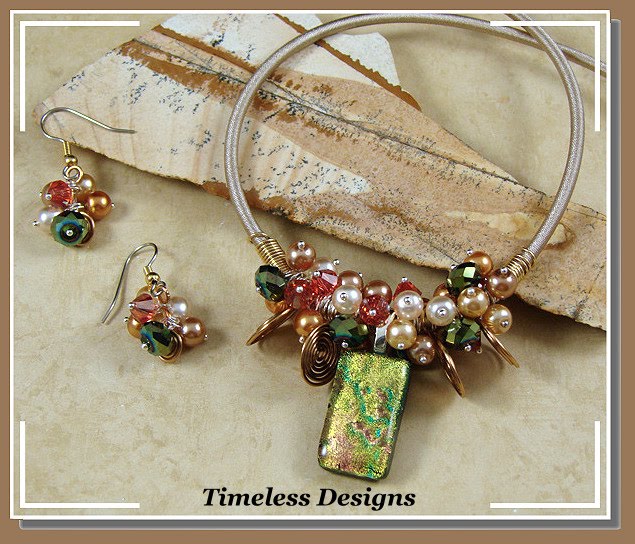
This is a different and new design in that it is a melt of different techniques. It starts with a focal pendant in dichroic glass from one of the premier glass artists in San Antonio; soft shades of lime green, gold, pink and cream set against a black background.


Surrounding the pendant are 36 individually hand-charmed pieces; in accents of faceted Swarovski crystals hot pink padparadscha and glass pearls in complimenting colors of cream, mauve, copper, tan, and metallic green crystals. Between are hand-swirls spirals in non-tarnish brass wire and non-tarnish brass spiral ends for accents. It is set stationary onto the silky 18” tan cord and has matching dangle cluster earrings.


Keep watching as we’ll be doing this design using many other pendants, cords and techniques!


Eclectic artisan crafted jewelry from fossils, glass, and stone incorporated with metals and wire techniques; visit our online Shop for available pieces to purchase!

Sunday, July 18, 2010

Spiny Oyster & Jewelry

Some of the most incredible Southwestern and Indian jewelry is made with Spiny Oyster beads. The colors of these beads vary from pink to purple and from light to deep orange. Spiny oyster beads come from the spiny oyster shell, or Spondylus, harvested from the Sea of Cortez, Baja California and Mexico. Different types of Spondylus may also be found in the warm waters off the coasts of Central and South America. Spondylus is Latin for “spines on its back,” which is appropriate for this beautify and difficult to harvest shell.

It was hard to find information about just the beads, but I did find out about the Spiny Oyster Shell from the Wikipedia. “Spondylus is a genus of bivalve mollusks, the only genus in the family Spondylidae. As well as being the systematic name, Spondylus is the most often used common name for these animals, though they are also known as thorny oysters or spiny oysters.

There are many species of Spondylus, and they vary considerably in appearance and range. They are grouped in the same super family as the scallops, but like the true oysters (family Ostreidae) they cement themselves to rocks, rather than attaching themselves by a byssus. Their key characteristic is that the two parts of their shells are hinged together with a ball and socket type of hinge, rather than a toothed hinge as is more common in other bivalves. Spondylus have multiple eyes around the edges of the shell, and they have a relatively well developed nervous system. Their nervous ganglia are concentrated in the visceral region, with recognizable optic lobes, connected to the eyes. Spondylus shells are much sought after by collectors, and there is a lively commercial market in them.

Archaeological evidence shows that people in Neolithic Europe were trading the shells of Spondylus gaederopus to make bangles and other ornaments as long as 5,000 years ago (Varna necropolis). The shells were harvested from the Aegean Sea but were transported far into the centre of the continent. In the LBK and Lengyel culture, Spondylus shells from the Aegean Sea were worked into bracelets and belt-buckles.

Spondylus princeps are also found off the coast of Ecuador, and have been important to Andean peoples since pre-Columbian times, serving as offerings to the Pachamama as well as some kind of currency. In fact much like in Europe the Spondylus shells also reached far and wide as pre-Hispanic Ecuadorian peoples traded them with peoples as far north as present-day Mexico and as far south as the central Andes. The Moche people of ancient Peru worshipped animals and the sea and often depicted Spondylus shells in their art.


Browse our online shop to purchase designs in spiny oyster!

*Parts have been reprinted from the Wikipedia.