Saturday, May 15, 2010

Multi Colored Turquoise

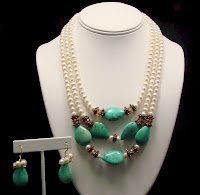
Capturing the beauty within the Southwest, graduated all natural Chinese Turquoise in an array of exploding colors blue, green, rust, olive and black then accented with pewter spacers and toggle. This is a stunner for summer and fall or any time of year with jeans and a t-shirt or that little black dress; designed by Gayle. Look for this design and several others in our collections.

Turquoise: Spiritual attunement, cleansing, healing, protection, valor, soothing, peace of mind, guidance through the unknown, romantic spontaneity.

Friday, May 14, 2010

Sapphire Not Just for the Gemstone


Well, the name sapphire just doesn’t extend to the gemstone, it also in this case is the name of one of the most stunning beaches in the Caribbean --


Sapphire Beach located on St. Thomas. Yes, the clear waters are a crisp clear blue with creamy sandy beaches and it is just as beautiful as the gemstone itself.

Tuesday, May 11, 2010

Wire Working Tools

So we discussed working with wire, but what about the tools used for wire working. There are several different types of jewelry making tool. I started out with the most common of the type, beading; and grew into wire working and sculpting. As I learn each technique and put my own twist of creativity into the design, I move into other more advanced or new techniques and types of jewelry making.

Here are a few of the most common used wire working tools; at least from my studio. I would recommend first though, before investing into the tools and wire that you take a class from your local craft, hobby or beading store. This will give you the chance to really get your hands ‘dirty’ before putting out the money in the right tools and wire.

Wire working tool are some of the same ones that are used in every type of jewelry making; however there are a few specialty tools for working with heavy gauge wire and to make things like jump rings, connectors and findings. Here are some of the more common essential wire working tools. In future posts, I’ll be listing some specialty wire working tools and techniques.

Bent Nose Pliers(to the right): Use these to shape or straighten wire and to hold it in place while using other tools. I keep a pair of both large and small sizes to fit most projects. Inspect your pliers before purchase and avoid any with notches on the inside as that can scratch wire. Over time, your pliers will start to show wear and tear; to keep them around longer I wrap blue painters tape around the jaws to keep from marring the wire.

Round Nose Pliers(to the left): These are perfect for curving wire or making hooks and loops, which can be used as findings or for attachment pieces. Again here I have several different sizes ranging from small, medium and large depending on the design, stones and project.

Chain Nose Pliers (to the right): These pliers a are square on the outside, flat on the inside, with a tapered nose to reach small places. These are excellent for making angles in wire.

Wire Cutters (to the left): These are used to cut normal wire such as gold, sterling, and artistic wire. Do not confuse them with the specialty memory wire cutters that are only used to cut memory wire. The sharper the cutter, the better, as it will last longer.

Jeweler’s Files (to the right): These come in sets with several sizes and shapes which are used to smooth off the metal. Wooden handles make it more comfortable to hold than all metal files; but is not necessary. Whatever your choice, make sure to get a variety of sizes and shapes to fit any project.


Bench Block (to the left): This is one of my favorite wire working tools; it is used to flatten wire and metal. It gives you a nice, sturdy, solid surface to work from.

Chasing Hammer (to the right): This round tipped hammer is used with the bench block to hammer wire flat. You can also use it in more advanced techniques to give a more hammered or textured look to your wire or metals.


Thing-a-ma-jig Wire Jig (to the left): For making just about any loop, curve, link, or design, a wire jig makes it easy. If you can draw or move a string in any shape, then you can do the same thing with wire in a jig.

Sunday, May 9, 2010

Working with Wire

In a lot of my designs I use different metals, quite often I try to do something with wire; either as links, swirls, or freeform wire on a stone or pendant. When working with wire gives my imagination that little added bit of ‘flare, spice, or spark’ that I’m looking for when working with natural stones, glass, pendants, or crystals. Most often I get asked, “How do you know which is the right size and what material is best?” The answer, you just learn with much time, research and patience.

One of the first things you need to consider when working with wire is to look at durability, malleability, style, color and manufacturer.
Wire is measured in gauges, from 16 all the way to 34; with 16 being the heaviest/thickest and 34 being the smallest/thinnest wires. Typically, the thicker the wire, the sturdier it will become. However, the type of material used for the wire also affects how flexible a particular gauge will be.


Rules of Thumb
*For bracelets, heavy necklace pendants designs or winding wire around very large beads, making charms or creating chain links, a 16 to 18 gauge is suggested.
*Gauges 20 to 24 are considered medium to thin thickness and are good for wire wrapping beads, as well as for constructing findings, headpins, and ear wires. This is typically the gauge used for making earrings and 20 or 22 are the best for ear wires.
*The smallest, skinniest wires are 26 to 34 gauges. They are easily manipulated and flexible, perfectly for use with small beads in embroidery and stitch projects. You can find wire in brass, copper, pewter, or artistic non-tarnish are inexpensive and typically soft wires to work with; while sterling silver and gold filled are more expensive and typically vary in hardness’s from dead-soft to half-hard.
*Sterling Silver is great looking and made soft or hard. The only thing to remember is that silver will tarnish.
*For wire that will not tarnish and will retain its beauty and luster, try working with non-tarnish wires; it is very inexpensive and usually made from a copper core; covered with silver, gold, or colored coating that has been treated so that it will not tarnish.
*While the others run the spectrum of price; the most expensive wire to work with is gold or gold-filled, which does not tarnish. Some wire works will substitute gold-plated wire for cost effective designs.

Whatever your choice, you will find that working with wire brings out the artist and craftsman in every design.
Browse our available to purchase designs combining wire and other metals.

Saturday, May 8, 2010

Mexican Lace Agate Jewelry Redesign

This Mexican Lace Agate pendant is a stunning piece of nature’s work and paired with Picture Jasper it was all about the yellow. The set was very well done, but sort of lacked that ‘pop’ and my mother-in-law was about to take it apart when I asked if I could work the piece, thinking first I would try to mix it with some Turquoise, though that didn't work.

I wanted to really bring out the black in the pendant, since that is what is amazing about it. I started mixing it up with large pieces of Onyx to enhance the large pendant, hand charming all the chips, pearls, and faceted onyx pieces into clusters, threw in Ivoryite for a little color to bring out the cream of the pendant and pewter and gunmetal for some texture. It’s still got the same beautiful look of yellow but now has a stronger feel of black thrown in to give it that extra ‘pop’ that she was looking for.


Jaspers: Protection, nurturing, joy, awareness; balancing of physical, emotional, intellectual and spiritual energies.
Onyx: Self-control, decision making, intuition, recognition of personal strengths.


Visit our collections for many different designs to find something that fits your personality.

Friday, May 7, 2010

Mother-of-Pearl Crystal Bling

Classy, sassy and chic design that says Bling in a big way; the highlight is a huge mother-of-pearl pendant that is slick on one side and concave with the blister pearls on the other (could wear either direction). The crystals are faceted metallic black diamond that has an almost shimmer effect; crystal spacers and fresh water cultured pearls, some charmed above the pendant and also in the earrings.

Mother of Pearl: Mental clarity, intuition, sensitivity, imagination, adaptability, cooperation.
Pearl: Purity, faith, charity, innocence, integrity, focus, wisdom, spirituality, sincerity, fertility.
Find many designs to fit your personality are available on our website.

Wednesday, May 5, 2010

Traveling with Jewelry Tips

As the summer draws near, so do those plans of vacations; rather abroad, here and there or close to home. Whatever the case, everyone will be traveling and doing so with their jewelry. Many people pack their jewelry in their suitcases, rather than as carry-on. While this maybe an ‘ok’ thing, it would not be advised to allow your high-end expensive, heirloom or even your nice costume jewelry to chance in the suitcase, suggest carry-on so that you know it makes it all the way through to your trip, especially if you are flying. A hotel security director recommends to, ““Never take your heirlooms and your favorite jewelry items with you.” Though that would be nice, we all want to take that favorite jewelry piece with us. So from the Travel Safety Tips website here are some suggested tips for traveling with your jewelry.
1) Be sure you are staying in a hotel or resort with a safe in the room or safety deposit boxes at the front desk; most 3-star or higher hotels/resorts are required to have both.2) Once you've checked into the hotel, use the safe or safety deposit box. The hardest part for the hotel is getting people to utilize them. Hotels advertise having them, but then guests don't use them and that's where things can go wrong for the hotel guests.3) Know the hotel polices you are staying in if something should happen to your jewelry. In most U.S. states, a hotel manager is not liable for hotel losses, unless they are the direct result of the hotel's negligence. For example, if a hotel employee is caught stealing it.

An insurance agent suggests if you own fine jewelry, you probably have (or should have) insurance to cover it, especially if it is something of value or an heirloom. Just make sure that your insurance policy covering any jewelry extends to that of traveling. A standard homeowner's policy will not cover jewelry for disappearance and it will only cover theft of jewelry up to $1,000. The key is to purchase a rider to your homeowner's policy or a separate policy to cover just the jewelry. Either one will cover your jewelry for theft, disappearance or other mishaps, including losing a stone from a setting or unfortunate incident.
Make sure to check with your agent to find out what your specific policy rules are for traveling with your jewelry. Most standard policies will cover you for travel anywhere, but some might require that certain items be kept in a safe when you are not wearing them. Sorry to say that most insurance agents will advise that it is best to leave the heirlooms at home and I’m sure you’ll agree so as not to loose that precious piece of family history; but then, we’d never get to show off that great jewelry either if we did.

Lastly, be aware of your surroundings and where you are traveling before wearing that necklace, bracelet or ring you cherish and love so much. Wearing them at a party or special gathering is one thing, but wearing them in public going to and from that ‘big event’ can sometimes lead to trouble when least expected.

Visit our collection for summer designs to add to your jewelry box.
*Travel information from TravelSafetyTips.

Saturday, May 15, 2010

Multi Colored Turquoise

Capturing the beauty within the Southwest, graduated all natural Chinese Turquoise in an array of exploding colors blue, green, rust, olive and black then accented with pewter spacers and toggle. This is a stunner for summer and fall or any time of year with jeans and a t-shirt or that little black dress; designed by Gayle. Look for this design and several others in our collections.

Turquoise: Spiritual attunement, cleansing, healing, protection, valor, soothing, peace of mind, guidance through the unknown, romantic spontaneity.

Friday, May 14, 2010

Sapphire Not Just for the Gemstone


Well, the name sapphire just doesn’t extend to the gemstone, it also in this case is the name of one of the most stunning beaches in the Caribbean --


Sapphire Beach located on St. Thomas. Yes, the clear waters are a crisp clear blue with creamy sandy beaches and it is just as beautiful as the gemstone itself.

Tuesday, May 11, 2010

Wire Working Tools

So we discussed working with wire, but what about the tools used for wire working. There are several different types of jewelry making tool. I started out with the most common of the type, beading; and grew into wire working and sculpting. As I learn each technique and put my own twist of creativity into the design, I move into other more advanced or new techniques and types of jewelry making.

Here are a few of the most common used wire working tools; at least from my studio. I would recommend first though, before investing into the tools and wire that you take a class from your local craft, hobby or beading store. This will give you the chance to really get your hands ‘dirty’ before putting out the money in the right tools and wire.

Wire working tool are some of the same ones that are used in every type of jewelry making; however there are a few specialty tools for working with heavy gauge wire and to make things like jump rings, connectors and findings. Here are some of the more common essential wire working tools. In future posts, I’ll be listing some specialty wire working tools and techniques.

Bent Nose Pliers(to the right): Use these to shape or straighten wire and to hold it in place while using other tools. I keep a pair of both large and small sizes to fit most projects. Inspect your pliers before purchase and avoid any with notches on the inside as that can scratch wire. Over time, your pliers will start to show wear and tear; to keep them around longer I wrap blue painters tape around the jaws to keep from marring the wire.

Round Nose Pliers(to the left): These are perfect for curving wire or making hooks and loops, which can be used as findings or for attachment pieces. Again here I have several different sizes ranging from small, medium and large depending on the design, stones and project.

Chain Nose Pliers (to the right): These pliers a are square on the outside, flat on the inside, with a tapered nose to reach small places. These are excellent for making angles in wire.

Wire Cutters (to the left): These are used to cut normal wire such as gold, sterling, and artistic wire. Do not confuse them with the specialty memory wire cutters that are only used to cut memory wire. The sharper the cutter, the better, as it will last longer.

Jeweler’s Files (to the right): These come in sets with several sizes and shapes which are used to smooth off the metal. Wooden handles make it more comfortable to hold than all metal files; but is not necessary. Whatever your choice, make sure to get a variety of sizes and shapes to fit any project.


Bench Block (to the left): This is one of my favorite wire working tools; it is used to flatten wire and metal. It gives you a nice, sturdy, solid surface to work from.

Chasing Hammer (to the right): This round tipped hammer is used with the bench block to hammer wire flat. You can also use it in more advanced techniques to give a more hammered or textured look to your wire or metals.


Thing-a-ma-jig Wire Jig (to the left): For making just about any loop, curve, link, or design, a wire jig makes it easy. If you can draw or move a string in any shape, then you can do the same thing with wire in a jig.

Sunday, May 9, 2010

Working with Wire

In a lot of my designs I use different metals, quite often I try to do something with wire; either as links, swirls, or freeform wire on a stone or pendant. When working with wire gives my imagination that little added bit of ‘flare, spice, or spark’ that I’m looking for when working with natural stones, glass, pendants, or crystals. Most often I get asked, “How do you know which is the right size and what material is best?” The answer, you just learn with much time, research and patience.

One of the first things you need to consider when working with wire is to look at durability, malleability, style, color and manufacturer.
Wire is measured in gauges, from 16 all the way to 34; with 16 being the heaviest/thickest and 34 being the smallest/thinnest wires. Typically, the thicker the wire, the sturdier it will become. However, the type of material used for the wire also affects how flexible a particular gauge will be.


Rules of Thumb
*For bracelets, heavy necklace pendants designs or winding wire around very large beads, making charms or creating chain links, a 16 to 18 gauge is suggested.
*Gauges 20 to 24 are considered medium to thin thickness and are good for wire wrapping beads, as well as for constructing findings, headpins, and ear wires. This is typically the gauge used for making earrings and 20 or 22 are the best for ear wires.
*The smallest, skinniest wires are 26 to 34 gauges. They are easily manipulated and flexible, perfectly for use with small beads in embroidery and stitch projects. You can find wire in brass, copper, pewter, or artistic non-tarnish are inexpensive and typically soft wires to work with; while sterling silver and gold filled are more expensive and typically vary in hardness’s from dead-soft to half-hard.
*Sterling Silver is great looking and made soft or hard. The only thing to remember is that silver will tarnish.
*For wire that will not tarnish and will retain its beauty and luster, try working with non-tarnish wires; it is very inexpensive and usually made from a copper core; covered with silver, gold, or colored coating that has been treated so that it will not tarnish.
*While the others run the spectrum of price; the most expensive wire to work with is gold or gold-filled, which does not tarnish. Some wire works will substitute gold-plated wire for cost effective designs.

Whatever your choice, you will find that working with wire brings out the artist and craftsman in every design.
Browse our available to purchase designs combining wire and other metals.

Saturday, May 8, 2010

Mexican Lace Agate Jewelry Redesign

This Mexican Lace Agate pendant is a stunning piece of nature’s work and paired with Picture Jasper it was all about the yellow. The set was very well done, but sort of lacked that ‘pop’ and my mother-in-law was about to take it apart when I asked if I could work the piece, thinking first I would try to mix it with some Turquoise, though that didn't work.

I wanted to really bring out the black in the pendant, since that is what is amazing about it. I started mixing it up with large pieces of Onyx to enhance the large pendant, hand charming all the chips, pearls, and faceted onyx pieces into clusters, threw in Ivoryite for a little color to bring out the cream of the pendant and pewter and gunmetal for some texture. It’s still got the same beautiful look of yellow but now has a stronger feel of black thrown in to give it that extra ‘pop’ that she was looking for.


Jaspers: Protection, nurturing, joy, awareness; balancing of physical, emotional, intellectual and spiritual energies.
Onyx: Self-control, decision making, intuition, recognition of personal strengths.


Visit our collections for many different designs to find something that fits your personality.

Friday, May 7, 2010

Mother-of-Pearl Crystal Bling

Classy, sassy and chic design that says Bling in a big way; the highlight is a huge mother-of-pearl pendant that is slick on one side and concave with the blister pearls on the other (could wear either direction). The crystals are faceted metallic black diamond that has an almost shimmer effect; crystal spacers and fresh water cultured pearls, some charmed above the pendant and also in the earrings.

Mother of Pearl: Mental clarity, intuition, sensitivity, imagination, adaptability, cooperation.
Pearl: Purity, faith, charity, innocence, integrity, focus, wisdom, spirituality, sincerity, fertility.
Find many designs to fit your personality are available on our website.

Wednesday, May 5, 2010

Traveling with Jewelry Tips

As the summer draws near, so do those plans of vacations; rather abroad, here and there or close to home. Whatever the case, everyone will be traveling and doing so with their jewelry. Many people pack their jewelry in their suitcases, rather than as carry-on. While this maybe an ‘ok’ thing, it would not be advised to allow your high-end expensive, heirloom or even your nice costume jewelry to chance in the suitcase, suggest carry-on so that you know it makes it all the way through to your trip, especially if you are flying. A hotel security director recommends to, ““Never take your heirlooms and your favorite jewelry items with you.” Though that would be nice, we all want to take that favorite jewelry piece with us. So from the Travel Safety Tips website here are some suggested tips for traveling with your jewelry.

1) Be sure you are staying in a hotel or resort with a safe in the room or safety deposit boxes at the front desk; most 3-star or higher hotels/resorts are required to have both.2) Once you've checked into the hotel, use the safe or safety deposit box. The hardest part for the hotel is getting people to utilize them. Hotels advertise having them, but then guests don't use them and that's where things can go wrong for the hotel guests.3) Know the hotel polices you are staying in if something should happen to your jewelry. In most U.S. states, a hotel manager is not liable for hotel losses, unless they are the direct result of the hotel's negligence. For example, if a hotel employee is caught stealing it.

An insurance agent suggests if you own fine jewelry, you probably have (or should have) insurance to cover it, especially if it is something of value or an heirloom. Just make sure that your insurance policy covering any jewelry extends to that of traveling. A standard homeowner's policy will not cover jewelry for disappearance and it will only cover theft of jewelry up to $1,000. The key is to purchase a rider to your homeowner's policy or a separate policy to cover just the jewelry. Either one will cover your jewelry for theft, disappearance or other mishaps, including losing a stone from a setting or unfortunate incident.

Make sure to check with your agent to find out what your specific policy rules are for traveling with your jewelry. Most standard policies will cover you for travel anywhere, but some might require that certain items be kept in a safe when you are not wearing them. Sorry to say that most insurance agents will advise that it is best to leave the heirlooms at home and I’m sure you’ll agree so as not to loose that precious piece of family history; but then, we’d never get to show off that great jewelry either if we did.

Lastly, be aware of your surroundings and where you are traveling before wearing that necklace, bracelet or ring you cherish and love so much. Wearing them at a party or special gathering is one thing, but wearing them in public going to and from that ‘big event’ can sometimes lead to trouble when least expected.

Visit our collection for summer designs to add to your jewelry box.
*Travel information from TravelSafetyTips.